Wednesday, 28 January 2015

Test Marketing – Blog 7

Test Marketing – Blog 7

Test marketing is the seventh stage in the new product development process. During this stage the concept product or service is introduced into a limited market to determine the reactions of potential consumers of a product (Mcdaniel, Lamb and Hair, 2011).  Test Marketing is when the concept product or service and the marketing mix are tested in realistic market settings (Kotler and Armstrong 2012).  Test Marketing however can be very expensive, as costs are usually high, however it is cheaper to make a mistake at this stage than it is making a mistake once you fully go into business, as reputations can be ruined by one small fault (Armstrong et al 2009).  It allows management to evaluate alternative strategies and to assess how well aspects of the marketing mix fit together (Mcdaniel, Lamb and Hair, 2011). A marketing program consists of a whole range of concepts including the positioning strategy, promotion, distribution, pricing and packaging (Kotler and Armstrong 2012).

According to scotlandfoodanddrink.org test marketing helps companies answer a number of critical questions about your product or service. Target marketing also gives companies some ‘real’ information on difficult topics such as purchasing habits. Scotlandfoodanddrink.org also suggest that by conducting test marketing a business will have an evaluation of demand and also reduced investment risk. Scotlandfoodanddrink.org also list three types of Test marketing, simulated store test, controlled test and standard test marketing.

For Archball, Simulated store test marketing would be the most appropriate, this method will allow the company to collect useful information in a controlled way, results will be quick and also the advertising effectiveness can be evaluated. This method is also the cheapest of the three, and for a new company this is an important factor.  The company would invite 30-40 people from its target group (15-25) to come and try out the new sport, we would observe the natural reaction to the sport and then ask each individual to complete a structured interview at the end of the day (Appendix 1). During the day the sample of consumers will also be shown the promotional plans including the packaging and advertising ideas, there will also be questions regarding this on the interview. Each session would last approximately between 2 and 3 hours, (1 hour playing, 1-2 hours to complete all interviews). The company would hold two sessions per day for two weeks at Coach Lane Campus, Northumbria University, Newcastle.


Once we analyze the results the company will then go on to a staged rollout, product or service modifications or a national launch.  However there are some disadvantages to test marketing, competitors may try to interfere with your research or competitors may try to copy your idea and bring it to market before you do.


Appendix

1) The questions for the Structured Interview.


Structured interview:

  • 1.     On a scale of 1-10 how much did enjoy the sport? (1 not at all, 10 best sport ever played)
  • 2.     On a scale of 1-10 how often would you part take in this sport? (1 never – 10 daily)
  • 3.     On a scale of 1-10 how reasonable was the pricing in your opinion? (1 much to expensive, 10 very cheap)
  • 4.     On a scale or 1-10 how eye catching is the packaging (1 not at all, 10 very)
  • 5.     On a scale of 1-10 how interesting were the adverts? (1 not at all, 10 very)
  • 6.     Do you think the sport would be attractive if we used a celebrity endorsement? Yes / No
  • 7.     If Yes, do you think a professional football player or a well-known TV personality would have a better impact for the sport? Pro Footballer / TV personality
  • 8.     If there is anything you could change about the sport itself or the promotion of it (Packaging/adverts etc) what would you change? 

    References 

     Armstrong, G., Kotler, P., Harker, M & Brennan, R (2009). Marketing and introduction. Harlow: Pearson Education Limited

How do I: Conduct a Test Market?. (2015). [online] Available at: http://www.scotlandfoodanddrink.org/site/guide_doc/How-do-I-conduct-a-test-market-2.pdf [Accessed 26 Jan. 2015].

Kotler, P.  & Armstrong, G. (2012) Principles of Marketing14th Edn. London: Pearson Education.

Mcdaniel, C.D, Lamb, C.W, & Hair J.F, (2011) Introduction to Marketing 11th Edn. Ohio: South-Western Cengage Learning.





Wednesday, 21 January 2015

W13017467 - Product development - Blog 6


Product development Blog 6

Product development is the sixth stage in the NPD process, product development is where the concept is developed into a tangible product allowing the design team to evaluate the products functionality and see if the product meets consumer needs (Armstrong, Kotler, Harker and Brennan, 2009), in this case a new sport concept will be evaluated rather than a product although it follows a similar procedure. The aims of this stage are to design a prototype that will satisfy customers, produced quickly and at a budgeted cost (Kotler and Armstrong, 2012). The marketing department should also decide on the products packaging and branding (Mcdaniel, Lamb and Hair, 2011).
One sporting example of product development can be seen on soccerreviews.com (2012). One post in particular shows how a global brand (Warrior) are using product development, they were in the process of producing football boots for the first time, so they had given a number of professional players a pair of their prototypes and allowed them to train in the. This gave Warrior the opportunity to get feedback from the players, who would advise them on how the boots could be improved to satisfy customers and functions correctly. In this specific instance the player was Vincent Kompany, at the time he was the captain of Manchester city, the team who had just won the premier league that summer and captain of Belgium’s national team. Kompany is a high profile player, in the most watched league in the world; this could also be part of their marketing plans to promote the brand and their new products.
When it comes to the equipment required for Archball, the main face of the board will have a target on with different colours equalling different points, i.e. Black = 1, White = 2, Blue = 5, Red = 10 and Yellow = 20, however the target will have another target on the back with only three colours and bigger target area’s to make the game easier for beginners/children (Appendix A). The legs which hold the main face up will also be weighted to help it stand upright, although it will also come with pegs for outdoor use (Appendix B). Each board will also come with two special Archball balls which will be made small enough to make the game possible but challenging, approx. size 2 (Appendix C). The sport will be trialled using a number of focus groups to help the development of the sports and the equipment, for example the focus group suggest that the balls are too big and that it would be better with a smaller ball, or that the equipment should come with some sort of case to help the transportation from location to location. This stage will also be crucial to the pricing strategy of the company, the focus group may be willing to pay more than what we anticipated which would allow us to increase the retail price and increase our net profits.


Refrences

Armstrong, G., Kotler, P., Harker, M & Brennan, R (2009). Marketing and introduction. 8th edn, Pearson education ltd: Harlow.

Kotler, P. & Armstrong, G. (2012) Principles of Marketing14th Edn. London: Pearson Education

Mcdaniel, C.D, Lamb, C.W, & Hair J.F, (2011) Introduction to Marketing 11th Edn. Ohio: South-Western Cengage Learning

Perkins, B. (2012). Vincent Kompany Training in Warrior Sports Prototype Boot - Soccer Reviews. [online] Soccer Reviews. Available at: http://soccerreviews.com/news/unreleased-warrior-sports-skreamer-klite/ [Accessed 17 Jan. 2015].
 
Appendix
 
A) Targets


B) Pegs For Stand


C) Ball Size


Wednesday, 10 December 2014

Business Analysis – Blog 5


Business Analysis – Blog 5


Business Analysis is the fifth stage of the New Product Developments process; this stage of the process is when companies review the costs, such as start-up costs and continuing costs. Sales, such as the speed of sales and the seasonality of sales. Market share, such as strengths and weaknesses of competitors. And demand and profit projections of the new service or product concept to evaluate whether or not it fits the company’s overall objectives (Kotler and Armstrong, 2012). During this process companies also evaluate whether or not the new concept would benefit current consumers, what is the current national economic status and whether that would have an effect on sales and if the new concept would improve the image of the brand. (Lamb, Hair & McDaniel, 2011)

A real life sporting example of business analysis can be seen at RA Concepts, they are a company looking to secure start-up funding to produce and sell golf clubs. They aim to meet the ever growing demands for new technology in the golf industry by offering a new unique "D" style featherweight putter (RA concepts 2012). To help their bid to secure start-up funding they have made sales and profit projections to show that their business will be successful as the graph shows how much they expect they expect to make through sales, Gross Margin and Net Profit(Appendix A). They have also projected how much initial capital investment they require to start-up; this includes costs such as machinery and raw materials. RA Concepts project they would need a total of $126,000 investment, $15,150 would be spent on expenses, such as insurance and rent, the other $110,850 would be spent on assets such as the start-up inventory and long term assets (Appendix B).

When considering my Archball sports concept I will have to consider the start-up and continuing costs, the first cost I would come across would be the cost of patenting my concept, according to Thisismoney.co.uk, 2013 the average cost of patenting can be between £3,000 and £4,000. I would also encounter the costs of raw materials, production and marketing costs. Once I had projected all of those costs, it would give me a break-even amount, I would then project the sales of the concept including sales of the Archball board and the revenue created through facility hire. Once those figures are projected I can combine the two to project my margins, profit potential and time scale to break-even.
 

Bibliography

 Kotler, P. & Armstrong, G. (2012) Principles of Marketing 14th Edn. London: Pearson Education.
McDaniel, C.D. Lamb, C.W. & Hair J.F. (2011) Introduction to Marketing 11th Edn. Ohio: South-Western Cengage Learning.
RA Concepts (2012) Golf Club Manufacturer Business Plan. Available at: http://www.bplans.com/golf_club_manufacturer_business_plan/executive_summary_fc.php#.UMYttXdZyUc (Accessed 8th December 2014)
This is Money, (2013). How to protect your small business idea. Available at: http://www.thisismoney.co.uk/money/smallbusiness/article-1585163/Protecting-patenting-small-business-idea.html [Accessed 8 Dec. 2014].
 

Appendix

A)


B)


Wednesday, 3 December 2014

Marketing Strategy and Development Blog 4 - W13017467


Marketing Strategy and Development Blog  4

Marketing strategy and development is stage number four is the new product development process. This stage of the process involves companies creating an initial marketing strategy with the product or service concept developed. Companies then set out an initial marketing statement that highlights the target market of the concept, the desired market share of the concept, the desire sales of the concept and the amount that the company aim to make from the concept (Kotler and Armstrong, 2012).Organisations also need to consider the size of the market and the market behaviour to direct the marketing strategy to help their concept be a commercial success (Mcdaniel, Hair and Lamb, 2011).

BskyB have had huge commercial success with their concept SKY+, however this success has not come from huge cash investment, it has come as a result of a good marketing strategy. BskyB launched SKY+ in July 2001, they did not advertise and market the concept because they knew that customers would expect SKY+ to work flawlessly but they knew that they would have some problems as it was a brand new concept and the first of its kind Until recently the service has purposely received only low key marketing support” (Mercer 2003). They therefore took a more cautious approach to allow them to receive feedback form the ‘early adopters’ category of the Rogers Adoption Curve(Appendix 1), before they gave the concept a high profile marketing campaign. BskyB identified that each category of the curve required a different marketing strategy, using this information they put together a marketing strategy to ensure maximum commercial success. In 2003 BskyB reduced the price of SKY+ from £300 to £199 and they had a major advertising campaign costing £20m. (Sky Press Release, 08/09/2003). BskyB also used celebrities as part of their marketing strategy to help raise the profile and awareness of the concept to the public, BskyB chose radio presenters as some of the celebrities they used and they also then when on to mention the concept on air, giving BskyB even more recognition..

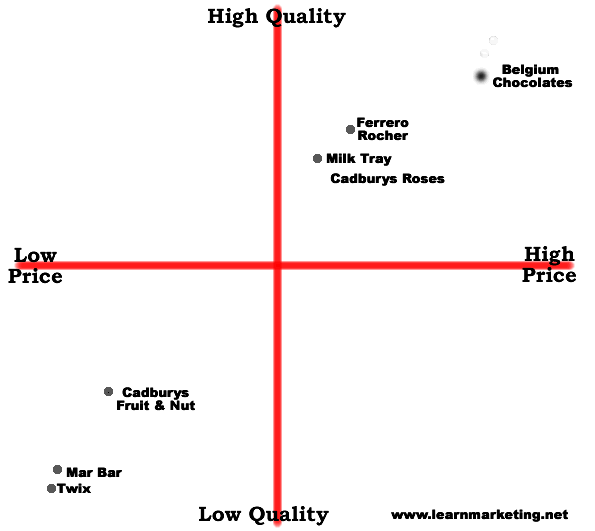
To develop my marketing strategy for my concept I would use a Position Strategy Graph (Appendix 2) to help me plot my concept and create the an ideal price. I would then use a strategy similar to BskyB of not marketing the concept too much initially so that I can get some feedback from the early adopter which I may use to improve the concept. I would then invest in a marketing strategy to raise the profile of my concept, I would use well known footballers to help me create a TV advert from which I would also use still images to create poster campaigns and radio adverts. The advertisements would concentrate on the ‘Product’ section of the Marketing Mix (Learnmarketing.net, 2014. Appendix 3) to promote the sport and what it actually consists of as it is a brand new sport concept.
 
References
Baker, Michael and Hart, Susan (2007), Product Strategy and Management, Harlow: Pearson Education Limited.
Kotler, P. & Armstrong, G. (2012) Principles of Marketing, 14th Edn, London: Pearson Education.
Learnmarketing.net, (2014). Perceptual Maps/Positioning Maps. [online] Available at: http://www.learnmarketing.net/perceptualmaps.htm [Accessed 1 Dec. 2014].
Mcdaniel, C.D, Lamb, C.W.& Hair J.F. (2011) Introduction to Marketing 11th Edn, Ohio: South-Western Cengage Learning
Mercer, David (2003), “Can Sky Plus resolve its teething troubles?”, New Media Age. 1 May 2003, p.15.
Sky Press Release (2003), “BSkyB Sky+ Marketing Drive”. www.sky.com 08/09/2003
Appendix 1 Rogers Adoption Curve (Baker 2007)


Appendix 2 Position Strategy Graph


Appendix 3 Marketing Mix


Wednesday, 26 November 2014

Concept Development & Testing - Blog 3


Concept Development & Testing - Blog 3

Concept Development and Testing is the third stage in the new product development cycle. This stage is when companies test their new ideas, either products or services, before any prototype has been created. (Lamb,Hair,McDaniel, 2009).  The product or service concept development is a detailed description of the idea, in words easy to understand for the target market, to get that stage slight changes and altercations may be made to enhance the product or service. Whereas concept testing involves putting the developed concept idea to the target market and recording their response (Armstrong, Kotler, Harker, Brennan, 2009). Companies use the feedback they get from the target market to help aid the decision on which product or service they are going to continue developing. (Peng & Finn 2008).During concept testing companies often ask their target market questions such as, what is their perceived value of the concept? Meaning how much do they think it is worth to them, how much they would pay for it. Also questions like the typical purchasing frequency they could expect for their product?

Concept development and testing is happening right now in companies, for example FIFA tested their world cup ball with over 600 professional players and 30 teams in ten countries across three continents before the world cup in 2014. All of the balls FIFA produce are certified with a FIFA quality mark, this quality mark indicates to consumers that the ball is of top quality. (Quality.fifa.com, 2014)

Another sporting example of companies testing their products is Lycra Sport; Every Lycra Sport fabric style is tested to meet demanding standards for elongation, fit and recovery power. Lycra have created a graph to see record the results of their testing and only those products that fall within the desired results region of the graph are given the greenlight to continue with development. (Lycra.com, 2014) (See Graph - Appendix A) 

When I have developed my concept, Archball, I would test the concept by offering the idea to my target market. My target market is boys and girls aged between 13-21, I would ask my target market if the sport is easy to understand? I would also ask them if they would pay to play the sport with their money? How often they could see themselves playing the sport? Would they replace the sport they play now with my new sport concept? And reasons why they would or wouldn’t, and I would also ask them for any suggestions they think they will enhance the sport as a commercial business.


Appendix
 
A.


Refrences


Lamb, C., Hair, J. and McDaniel, C. (2009). Essentials of Marketing. 6th ed. Cengage Learning.


Lycra.com, (2014). LYCRA® SPORT fabric. [online] Available at: http://www.lycra.com/g_en/webpage.aspx?id=963 [Accessed 23 Nov. 2014].


Peng, L & Finn, A (2008). ‘Concept testing: the state of contemporary practice’, Marketing intelligence and planning. 26:6, pp. 649-674. Available at: http://www.emeraldinsight.com/journals.htm?articleid=1747079&show=abstract (Accessed: 23/11/2014).


Quality.fifa.com, (2014). adidas brazuca – tried and tested - FIFA Quality Programme. [online] Available at: http://quality.fifa.com/en/Footballs/Football-facts/adidas-brazuca--tried-and-tested/ [Accessed 23 Nov. 2014].